Enterprise IT faces a persistent challenge: not every workload can be virtualized. Despite the industry’s push toward VDI and cloud solutions, a substantial portion of critical business applications require dedicated physical hardware. Whether it’s specialized CAD software, high-frequency trading platforms, or GPU-intensive graphic design work, these non-virtualized users need guaranteed performance that virtual environments can’t always deliver.
The solution isn’t spreading desktop towers across office spaces—it’s consolidating dedicated systems into high-density rackmount workstations within your secure data center. High-density rackmount workstations offer an alternative to VDI for users who require dedicated hardware, delivering up to 70 systems per standard 42U rack while maintaining the performance benefits of physical computing resources.
Virtualization technology has advanced significantly, but fundamental limitations remain for certain use cases. Understanding when to deploy high-density rackmount workstations instead of VDI is critical for supporting power users:
Software licensing restrictions often tie applications to specific physical hardware, making virtualization legally or technically impossible. Many legacy and specialized applications simply weren’t designed for shared resource environments.
GPU performance disparities represent a major bottleneck. While virtual GPU (vGPU) technology continues improving, dedicated physical GPUs in rackmount workstations consistently outperform shared vGPUs in real-world testing, particularly for CAD, 3D rendering, and visual effects work.
Performance consistency matters critically for time-sensitive applications. Financial traders, medical imaging professionals, and real-time analysts cannot tolerate the performance “jitter” that virtualization can introduce. These users require guaranteed, latency-free computing power.
Data center space costs money—typically billed by the rack unit (U). A standard 42U rack represents significant monthly overhead in colocation fees, power consumption, and cooling costs. Maximizing density with high-density rackmount workstations directly reduces your total cost of ownership (TCO).
Traditional desktop PCs occupy office floor space, consume inefficient power, and create security vulnerabilities. Rackmount consolidation addresses all three problems simultaneously.
Traditional Desktop Approach:
High-Density Rackmount Workstation Approach:
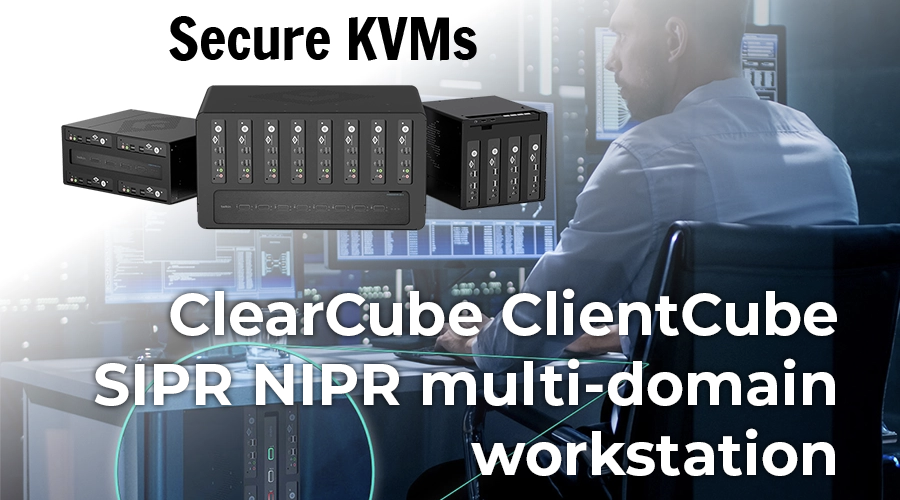
ClearCube specializes in high-density rackmount workstations designed specifically for non-virtualized users who require dedicated computing resources:
Blade PC Technology (0.6U per system): The A-Series Blade PCs deliver workstation-class performance in an ultra-compact form factor. Ten complete systems fit within a 6U rack-mounted case, providing dedicated CPU, RAM, and GPU resources for each user. This modular approach to high-density rackmount workstations allows IT teams to scale capacity incrementally while maximizing every inch of rack space.
NUC Consolidation (0.4U per system): For users requiring standard desktop PC capabilities, the Client Drawer consolidates up to ten NUC-style mini-PCs in a 4U rack enclosure. This represents the highest density option available—2.5 systems per rack unit—with active cooling and redundant power supplies ensuring reliability.
Rack-Mounted Workstations (1-2U per system): High-end power users running demanding CAD, GIS, or rendering applications can access dedicated 1U or 2U rackmount workstations equipped with high-performance CPUs and professional-grade GPUs (up to NVIDIA A6000). Even at 1U per system, a standard rack accommodates 42 dedicated workstations—providing exceptional density for non-virtualized environments.
Centralizing dedicated PCs in the data center immediately elevates security:
Simplified maintenance workflows: IT staff can service, upgrade, or replace systems without traveling to individual workstations. Hot-swapping failed components takes minutes, not hours.
Improved uptime: Redundant power supplies and better cooling extend hardware lifespan and reduce failure rates.
Centralized monitoring: Power consumption, thermal management, and system health can be monitored from a single dashboard.
Reduced end-user disruption: Hardware issues are resolved in the data center while users continue working on temporary systems via remote desktop protocols.
Example scenario: 30 power users requiring dedicated systems
Colocation scenario (assuming $100/U/month):
Power efficiency: Rackmount systems with redundant power supplies typically achieve 85-90% efficiency compared to 70-75% for traditional desktop power supplies, reducing electricity costs by 15-20%.
Before transitioning to rackmount infrastructure:
High-density rackmount deployments require robust network connectivity:
Users access their dedicated rackmount systems via:
CAD professionals working with AutoCAD, SolidWorks, or CATIA require dedicated GPU acceleration that vGPU solutions often can’t match. Rackmount workstations with NVIDIA Quadro or AMD Radeon Pro GPUs provide the dedicated performance these users demand while centralizing expensive hardware assets.
High-frequency trading algorithms require microsecond-level execution speeds. Even minimal performance variability can cost millions in trading opportunities. Dedicated rackmount systems eliminate the “noisy neighbor” problem inherent in virtualized environments.
Video editors, 3D animators, and graphic designers push hardware to its limits. Adobe Premiere Pro, DaVinci Resolve, and Autodesk Maya benefit dramatically from dedicated GPU resources and consistent CPU performance.
DICOM viewers and medical imaging analysis software often require dedicated hardware for regulatory compliance and guaranteed performance. Centralizing these systems in HIPAA-compliant data centers enhances security while maintaining performance.
High-density rackmount solutions offer unmatched scalability. Adding capacity means installing additional blade modules or rack units, not reconfiguring entire office layouts.
Centralized systems simplify hardware refresh cycles. Instead of replacing 50 distributed desktops over months, IT teams can upgrade entire racks in days with minimal user disruption.
Many organizations benefit from hybrid strategies: virtualized resources for general users and dedicated rackmount systems for power users. This balanced approach optimizes both cost and performance.
The assumption that all workloads should be virtualized overlooks the real-world requirements of power users and specialized applications. High-density rackmount workstations provide a practical, cost-effective alternative that doesn’t compromise performance for non-virtualized users.
By consolidating dedicated systems into space-efficient rack configurations, organizations achieve:
For IT leaders supporting non-virtualized workloads, high-density rackmount workstations represent the optimal balance of performance, security, and economic efficiency. Whether you need blade PCs for graphic designers, rackmount workstations for CAD engineers, or consolidated NUC deployments for standard desktop users, the right high-density solution ensures every user has the dedicated computing power they require without compromising your data center’s efficiency.
The video below discusses the advantages of rack-mounted servers in general, providing context for the density benefits of ClearCube’s specialized rackmount PCs and Blades.

Don’t let the need for dedicated systems compromise your data center’s efficiency. With ClearCube, you can achieve maximum rack density while providing every user with the dedicated, high-performance computing power they need.
A rackmount workstation is a computer specifically designed for individual user workloads and mounted in a standard 19-inch equipment rack. Unlike rackmount servers that typically run virtualized environments or multi-user applications, rackmount workstations provide each user with dedicated CPU, RAM, GPU, and storage resources. High-density rackmount workstations are measured in rack units (U), where 1U equals 1.75 inches of vertical space. They consolidate computing resources in a compact, space-efficient format compared to traditional desktop tower computers while maintaining the performance characteristics users need for demanding applications like CAD, video editing, and financial trading.
The number depends on the form factor of each system. A standard rack contains 42U of usable space. Traditional 1U rackmount workstations allow up to 42 systems per rack, while 2U systems accommodate 21 units. High-density rackmount workstation solutions using blade PC technology achieve significantly better density—up to 70 systems per rack (at 0.6U per blade) or even more with NUC consolidation drawers (0.4U per system, allowing up to 105 systems). The optimal density depends on your users’ performance requirements and whether they need high-end GPUs, which typically require more rack space per workstation.
High-density rackmount workstations are ideal when virtualization isn’t feasible for non-virtualized users due to software licensing restrictions, GPU performance requirements, or the need for guaranteed low-latency performance. Applications like CAD software (AutoCAD, SolidWorks), high-frequency trading platforms, and professional video editing (Adobe Premiere, DaVinci Resolve) often perform better on dedicated physical hardware than in virtualized environments where resources are shared. Rackmount workstations provide each user with dedicated computing resources while still offering the centralized management and security benefits of consolidating hardware in the data center. This approach eliminates the performance “jitter” and resource contention issues that can occur with VDI, making it the preferred choice for power users with demanding workloads.
Blade PCs are ultra-compact, modular computing systems designed specifically for individual user workloads, while traditional rackmount servers typically run virtualized environments or multi-user applications. Blade PCs provide each user with dedicated CPU, RAM, GPU, and storage resources in a form factor much smaller than standard rackmount servers—often 0.6U per complete system compared to 1-2U for traditional servers.
Space savings are substantial. For example, 30 traditional desktop PCs occupy approximately 1,500-3,000 square feet of office floor space (including desks, clearance, and workspace). Those same 30 systems deployed as blade PCs consume only 18U (approximately 31.5 inches) of vertical rack space—roughly 3.5 square feet of data center floor space. This represents a 400-800x reduction in physical footprint.
Initial hardware costs for rackmount systems may be higher than basic desktop PCs, but total cost of ownership (TCO) is typically much lower. Savings come from reduced data center space consumption (rack space rental), improved power efficiency, lower cooling costs, simplified maintenance, enhanced security, and longer hardware lifecycles in controlled server room environments. Most organizations achieve ROI within 12-24 months.
Several technologies enable remote access to rackmount PCs, including PC-over-IP protocols, RDP (Remote Desktop Protocol), and proprietary remote desktop solutions. The optimal choice depends on your use case. GPU-intensive applications benefit from protocols optimized for graphics performance, while general office users can use standard RDP. Zero clients and thin clients serve as lightweight user endpoints that connect to the centralized rackmount systems.
Yes, modern rackmount workstations support professional-grade GPUs including NVIDIA Quadro/RTX series, AMD Radeon Pro, and even data center GPUs like the NVIDIA A6000. While compact blade systems support mid-range GPUs suitable for most design work, 1U and 2U rackmount workstations can accommodate full-size, high-performance GPUs required for intensive CAD, 3D rendering, and simulation workloads.
Centralizing PCs in a data center provides multiple security layers: physical access is restricted to authorized IT personnel only, systems reside in climate-controlled, locked server rooms with surveillance, valuable hardware and sensitive data never leave the secure facility, and centralized management enables consistent security patching and monitoring. This approach eliminates the endpoint security vulnerabilities inherent in distributed desktop deployments.
One key advantage of rackmount infrastructure is rapid repair and replacement. IT staff can hot-swap failed blade modules or components without leaving the data center, often within minutes. Many systems feature redundant power supplies and other failover components. Users can quickly be redirected to spare capacity or temporary systems while repairs occur, minimizing downtime compared to waiting for on-site desktop PC service.
Rackmount systems are generally easier to maintain than distributed desktop deployments. All hardware resides in one centralized location with proper lighting, workspace, and tools. Upgrades can be performed during scheduled maintenance windows without disrupting users (who simply reconnect to upgraded systems). Cable management is simplified, and environmental monitoring prevents many common hardware failures before they occur.
Industries with specialized, performance-critical applications benefit most: Engineering and manufacturing (CAD/CAM software), financial services (trading platforms), creative professionals (video editing, 3D animation), healthcare (medical imaging), GIS and mapping, architecture and construction, and scientific research. Any organization with power users who require dedicated hardware but want centralized management should consider rackmount solutions.
Yes, standard 19-inch racks accommodate various rackmount equipment types. You can combine blade PC chassis, traditional rackmount workstations, network switches, storage arrays, and other infrastructure in the same rack. This flexibility allows you to optimize density based on each user population’s specific requirements while maintaining centralized management.
Power consumption varies based on system specifications, but rackmount deployments are typically more efficient than distributed desktops. Rackmount power supplies achieve 85-90% efficiency (often 80 PLUS Platinum or Titanium certified) compared to 70-75% for desktop PSUs. Centralized cooling in data centers is also more efficient than cooling distributed office spaces. A typical blade PC consumes 65-150W depending on configuration, while high-end workstations may draw 200-400W under load.
In controlled data center environments, rackmount hardware typically lasts 5-7 years compared to 3-4 years for desktop PCs in office environments. The consistent temperature, humidity control, cleaner air (less dust), and better power conditioning in server rooms all contribute to extended hardware lifecycles and improved reliability.
Yes, high-density rackmount deployments require robust network infrastructure. Each user session typically requires 50-150 Mbps of bandwidth depending on application requirements (higher for 4K displays or GPU-intensive work). Low-latency networking (sub-millisecond) is essential for responsive user experience. Plan for redundant network switches and multiple uplinks to prevent network bottlenecks from affecting many users simultaneously.
High-density systems generate significant heat that must be managed properly. Blade chassis typically include active cooling with front-to-back or side-to-side airflow. Data centers should maintain proper hot aisle/cold aisle configurations to optimize cooling efficiency. Most blade systems include temperature monitoring and can throttle performance or shut down to prevent overheating. Ensure your data center’s HVAC capacity can handle the thermal load before deployment.
Yes, rackmount PCs run standard operating systems including Windows 10/11, Windows Server, various Linux distributions, and specialized operating systems. They use the same x86-64 processors as desktop systems, ensuring full application compatibility. Users experience their dedicated rackmount system identically to a local desktop PC when accessed via remote desktop protocols.
IT professionals familiar with server room operations will find rackmount PC management straightforward. The main differences from desktop support involve rack installation procedures, cable management practices, and remote desktop troubleshooting. Most organizations report that centralized management actually reduces IT workload compared to supporting distributed desktops, as technicians have immediate physical access to all systems in one location.
The primary considerations include upfront infrastructure costs (racks, network equipment, remote access clients), dependency on network connectivity (users cannot work if the network fails), and the need for adequate data center cooling and power capacity. Organizations with very small user populations (fewer than 10 non-virtualized users) may not achieve sufficient ROI. However, for most enterprises with 20+ power users, the benefits far outweigh these considerations.