ClearCube Technology First to Market With Zero Clients Featuring Integrated SIPRNet Smart Card Readers for PCoIP

AUSTIN, Texas, Feb. 14, 2012 /PRNewswire/ — ClearCube Technology today announced that it has introduced two new zero client models featuring the latest Smart Card Readers for high security desktop authentication on the Secret Internet Protocol Routed Network (SIPRNet). The new zero clients, the CD9424 and the CD7424, feature fiber network connections and copper network connections, respectively.

ClearCube’s new zero client models integrate the latest SIPRNet Smart Card Reader that has become the PKI Office mandated standard.  ClearCube’s Zero Clients support 5v, 3v, and 1.8v smart cards including the new SIPR hardware token, eliminating the hassle of separate USB readers for specific smart cards. Because the new readers are integrated in ClearCube Desktop Zero Client devices, workspace clutter is reduced and user productivity is enhanced. Additional benefits of the new zero clients include:

  • Ability to securely carry credentials from one location to another
  • Higher posture on DoD SIPRNet
  • Elimination of usernames and passwords
  • Elimination of password resets

Compatible with specific versions of Omnissa View and the PCoIP protocol, ClearCube’s zero clients with SIPRNet smart card readers allow PCoIP pre-session authentication that verifies identity through the PCoIP encrypted protocol. All ClearCube Zero Clients are assembled and tested in the U.S. and are fully TAA-compliant.

“Integrating a single smart card reader capable of reading and authenticating smart cards that have a variety of voltages has been requested by many of our federal customers to simplify their security operations,” said Jim Zakzeski, VP of Business Development and Marketing, ClearCube.

For more information about the SIPRNet compatible line of ClearCube Desktop Zero Clients, please contact ClearCube Technology sales at 866-652-3500.

Need assistance or have a question?
Schedule one-on-one time with a ClearCube professional.

No matter where you are in the buying process, let our team of highly knowledgable staff assist you in your journey.
Additional Articles to Explore

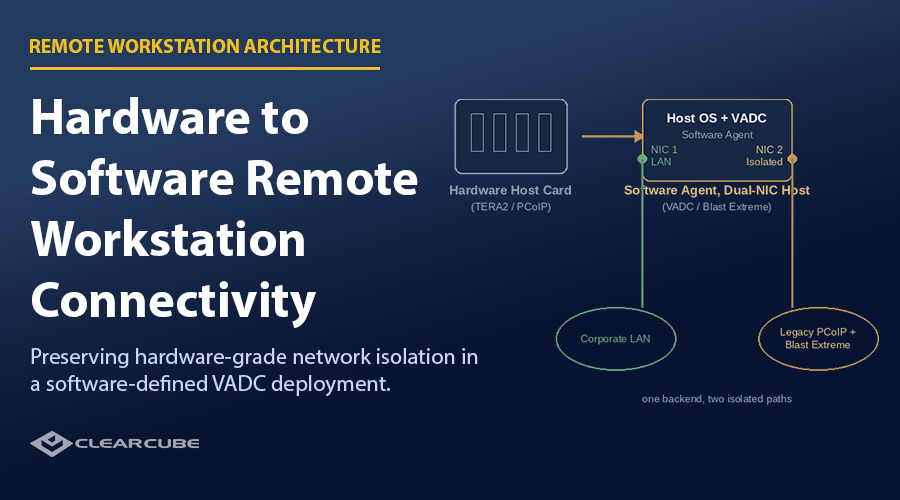
Preserving Network Isolation When Moving from Hardware-Based to Software-Based Remote Workstation Connectivity
For years, a dedicated hardware host card gave IT teams something software has struggled to replicate: a remote workstation that was completely invisible to the corporate data network. As more organizations move to software-based remoting agents, that isolation doesn’t have to disappear — a dual-NIC network topology reproduces it, with no connection broker required. This guide explains how the architecture works, and how legacy and modern endpoints can run on the same backend at the same time. Get the full white paper, free.
Read More
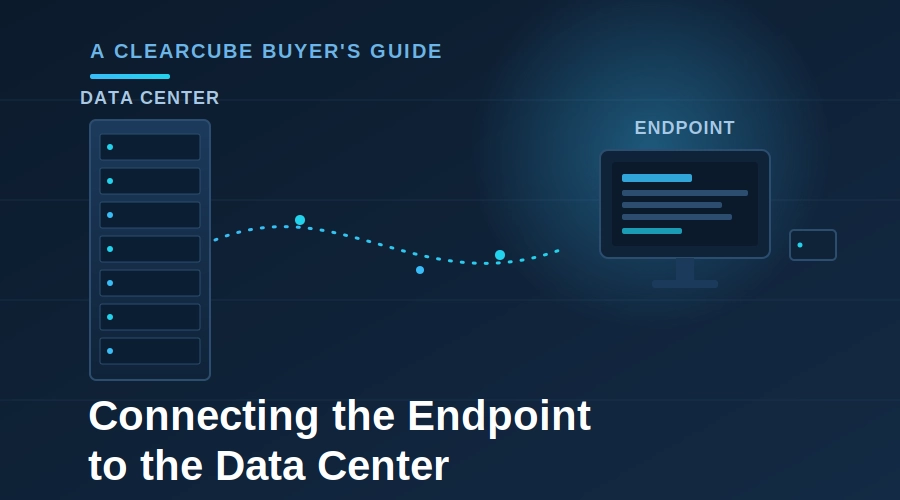
Choosing a Remote Desktop Protocol for Centralized Computing: A Buyer's Guide
Centralizing your endpoints in the data center is only half the decision — the other half is how each user connects to their machine. This guide breaks down the 15 best remote connection options, from standard VDI to the best for graphics and security. The ClearCube team has made this information (and ourselves) available so you can match the right connection option to your workload, security posture, and network. Get the full buyer’s guide, free.
Read More
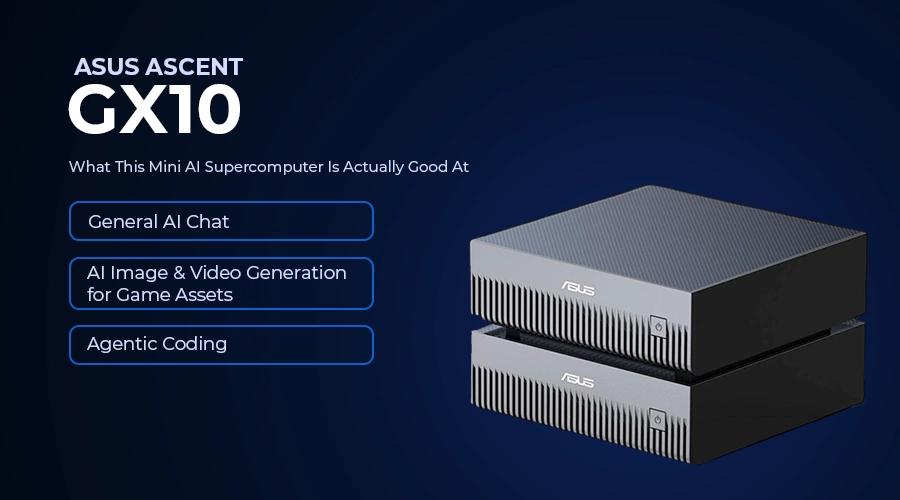
ASUS ASCENT GX10 Review: What This Mini AI Supercomputer Is Actually Good At (And Where It Isn't)
In this ASUS ASCENT GX10 review, a ClearCube customer put NVIDIA’s GB10 Grace Blackwell Superchip through three real AI workloads — general chat, image/video generation for game assets, and agentic coding — to see where this mini supercomputer excels and where cloud tools still win.
Read More